
Editorial policy
This editorial policy explains how MOT Check Online decides what to publish, where our facts come from and how we keep each page accurate after it goes live. It covers every guide, explanation and tool page on the site. Above all, it's the standard you can hold us to.
Updated · Owned by Hamza Akram, founder of MOT Check Online
Our editorial policy at a glance
In short
Every page starts from an official source, names the person responsible, shows when it last changed and gets corrected quickly when we're wrong. Advertisers never influence what we write, and AI tools never decide what's true.
Those promises matter more on a site like ours than on most. After all, a wrong MOT date can mean a fine, and a misread advisory can cost hundreds of pounds. So we treat accuracy as a feature, not an afterthought.
Who writes and checks our pages
Hamza Akram, the founder of MOT Check Online, writes and checks our pages and takes responsibility for everything we publish. He’s a web developer by background, not a mechanic. That’s exactly why every rule on the site traces back to an official source rather than to personal opinion.
We don’t currently use outside expert reviewers. If that changes, each reviewer will be a real, named person with a verifiable qualification, and their name will appear on the pages they’ve checked. We’ll never use invented authors, stock-photo “experts” or credentials we can’t back up. Google’s guidance on helpful, reliable, people-first content makes the same point, and we agree with it.
How we choose what to write about
We write to answer questions that real drivers and buyers ask. In practice, ideas come from three places:
- Searches that bring people here. If many people land on the site wanting to know when their first MOT is due, that deserves a clear answer.
- Messages from readers. A confused question in our inbox often points to a gap in a guide.
- Changes to the rules. When GOV.UK announces a new fee, a tax change or a consultation, we explain what it means for you.
Equally important is what we leave out. We won't publish on a topic we can't verify from a reliable source, and we won't chase a trending rumour before it's confirmed.
How our editorial policy ranks sources
Not every source deserves the same weight. Therefore, our editorial policy ranks them, and a lower tier can never overrule a higher one.
| Tier | Examples | How we use it |
|---|---|---|
| 1. Primary and official | GOV.UK, legislation.gov.uk, the MOT inspection manual, DVSA and DVLA data | The basis for every rule, fee, deadline and figure |
| 2. Other official bodies | The ICO, manufacturer recall notices on GOV.UK's recall checker | Supporting detail within their own area |
| 3. Established motoring organisations and press | Motoring organisations, consumer groups, national newspapers | Context and real-world examples, never the only source for a fact |
| Never used as a source | Forums, social media posts, AI chatbot answers, unsourced blogs | At most, a prompt to go and check the official position |
Where a guide quotes a number, it links to the page that number came from. As a result, you can always check our work yourself.
How a page goes from idea to published
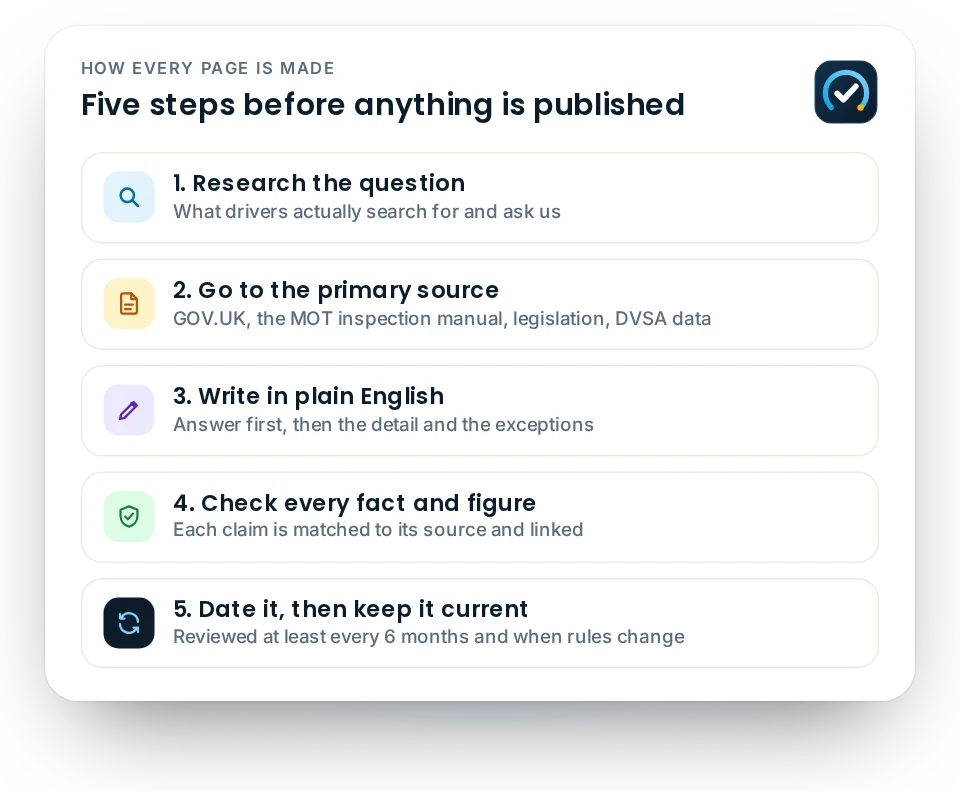
Every guide follows the same route. Admittedly, it's slower than publishing a first draft. Even so, it catches mistakes before you ever see them.
- Brief. We write down the exact question, who's asking it and which official sources will answer it.
- Research. We read each source in full, including the exceptions, and note where rules differ between Great Britain and Northern Ireland.
- Draft. We put the direct answer first, then the detail, in short sentences and plain English.
- Fact-check. Each figure, date, fee and deadline is checked against its source, line by line, and linked.
- Polish. We check headings, readability and image descriptions, so the page works for screen readers and quick skimmers alike.
- Publish and date. The page goes live with its "Updated" date, its author and its sources.
Fact-checking standards
Fact-checking isn't one step at the end. Instead, it runs through the whole process. In particular, our editorial policy applies these rules to every sentence:
- Every fee, fine, tax rate and deadline links to the official page it came from.
- Figures that change over time, such as the maximum MOT fee, carry the date we checked them.
- We say which part of the UK a rule covers whenever it differs between nations.
- Proposals and consultations are labelled as proposals, never written up as law.
- "Must" means a legal requirement; "should" means good practice. We don't mix them up.
- Example registrations and figures are clearly marked as examples.
How our editorial policy covers AI tools
We believe you deserve to know how our pages are made, so here's the honest answer. We use AI writing tools to help with parts of the work: summarising long official documents, suggesting outlines, drafting first versions and tightening our wording.
However, AI tools never decide what's true. Hamza checks every fact against the original source, rewrites anything that's inaccurate or unclear, and makes the final call on what's published. We also keep a few hard limits:
- AI never supplies vehicle data. Every MOT, tax and mileage result comes straight from the DVSA and DVLA records.
- AI is never a source. A chatbot's answer only ever prompts us to check the official position.
- No fake people or photos. We don't use AI-generated headshots or invented reviewers. Our illustrations are designed in-house and show example data, labelled as such.
Updates and review dates
MOT rules, fees and tax bands change. Because of that, every guide carries an "Updated" date, and we review each one at least every six months. We also review straight away when GOV.UK announces a change that affects a page.
In other words, the date only moves when the content changes in a way that matters to you, such as a new fee or a clearer explanation. Fixing a typo doesn't count, so we don't use it to make a page look fresher than it is.
Corrections under our editorial policy
We get things wrong occasionally, like everyone. What matters is how quickly and openly we put them right.
- Reporting an error: use the contact page and choose "Correction to a page or guide".
- Response time: we check every report and aim to fix confirmed errors within two working days.
- Showing the change: if a correction changes the meaning of a page, such as a wrong date or fee, we add a short, dated correction note at the end. Small fixes like spelling are corrected without a note.
Of course, if the error is in an official record itself, such as wrong mileage on an MOT, we'll explain who can fix it, because only the test centre or DVSA can change those records.
Independence, advertising and affiliate links
MOT Check Online is independent. No garage, dealer, insurer or manufacturer owns, funds or directs us.
The site pays its way through adverts from Google AdSense. Advertisers don't see our pages before publication, can't request changes and have no say in what we cover. Similarly, we don't accept payment, free products or gifts in exchange for coverage. If we ever earn commission from a link, the page will say so clearly, right next to it. You can read more about how adverts use cookies in our cookie policy.
Safety and the limits of our advice
Our guides explain rules and records. Still, they aren't a substitute for a qualified mechanic, an MOT tester or a solicitor. For that reason, we don't publish step-by-step repair instructions for safety-critical parts such as brakes, steering or suspension.
When a question depends on a particular vehicle's condition, we'll point you to a professional. Likewise, when it depends on the law in your circumstances, we'll point you to the official guidance on GOV.UK.
Editorial policy: frequently asked questions
Who is responsible for the content on MOT Check Online?
Hamza Akram, the site's founder, is responsible for every page. He writes and checks the guides and decides what's published.
Do advertisers influence what you write?
No. Adverts come through Google AdSense, and advertisers have no contact with our editorial work. Nobody can pay to change a guide or a report.
Do you use AI to write your pages?
AI tools help with research summaries, drafts and editing. A person checks every fact against the official source and approves every page before it's published.
How often do you update your guides?
We review every guide at least every six months, and immediately when an official rule, fee or tax rate changes.
How do I report a mistake?
Use the contact page and choose "Correction to a page or guide". We aim to fix confirmed errors within two working days.
If you think a page falls short of this editorial policy, please tell us. We'd much rather hear about it than have you trust something that's wrong.