
Hamza Akram
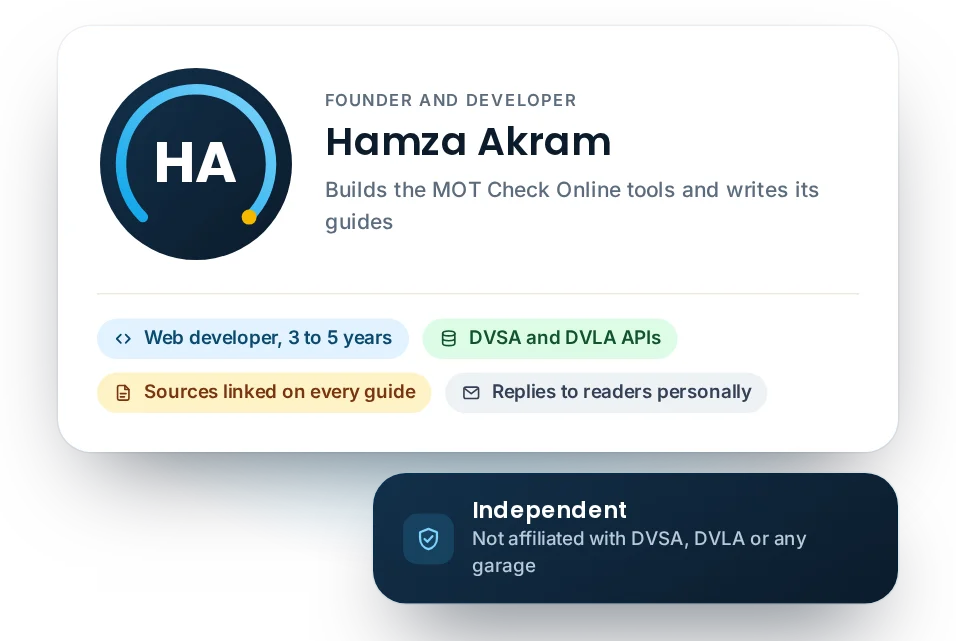
Hamza Akram is the founder and web developer behind MOT Check Online. He designed and built the site's free vehicle checks, from the number-plate search to the mileage chart, and he writes and fact-checks the guides that sit alongside them.
If you've used the site to check a car before buying it, you've used something Hamza made. This profile explains who he is, what he does and how he makes sure the information you read here is accurate.
Updated · About MOT Check Online · Editorial policy
About Hamza Akram
Hamza is a UK-based web developer with more than three years of experience building websites and data-driven tools. In particular, his work sits where code meets public information: taking records that already exist and making them fast, clear and easy to use.
Vehicle data caught his attention for a simple reason. The MOT and tax records behind every UK registration are public, yet most people find them hard to read. So Hamza built MOT Check Online to close that gap. As a result, anyone can now understand a car's history in a few seconds rather than a few hours.
What Hamza Akram does at MOT Check Online
MOT Check Online is a small, independent site, so Hamza wears several hats. In practice, his week covers five kinds of work:
Builds the vehicle checks
He designed the search, the report layout, the mileage chart and the colour-coded defect list.
Connects to the official data
He wrote the secure links to the DVSA MOT History API and the DVLA Vehicle Enquiry Service.
Writes and updates the guides
Every guide starts with official guidance and gets a fresh date whenever it changes.
Answers readers
Messages sent through the contact page reach Hamza directly, and he replies personally.
Keeps the site fast and private
He chose a set-up with no accounts, short-lived caching and no selling of data.
Experience and skills
Hamza's background is in web development, not motor engineering. That's why he works the way he does: he builds the tools, and he relies on official sources for the rules.
| Area | What it involves | Where you'll see it |
|---|---|---|
| Web development (3 to 5 years) | Building fast, accessible, mobile-friendly websites | Every page on MOT Check Online |
| API integration | Secure connections to government data services, with caching and error handling | Each MOT history check and tax result |
| Data presentation | Turning raw records into charts, status cards and plain-English labels | The mileage chart and defect explanations |
| Research and writing | Reading rules in full at the primary source, then explaining them simply | The MOT and car tax guides |
How Hamza Akram researches and checks his work
Good intentions alone don't make a page accurate. Instead, a repeatable process does. So, before anything goes live, Hamza follows the same five steps:
- Start at the official source GOV.UK, the MOT inspection manual, legislation and DVSA or DVLA documentation come first. Forums and other blogs never count as a source on their own.
- Read the whole rule He reads the full section, including exceptions, rather than a summary of it.
- Test it against real records Where a guide describes a report, he checks it against live results from the official data.
- Write it plainly The answer comes first, then the detail, then the exceptions, in short sentences.
- Date it and keep it current Each page shows when it last changed, and he reviews guides when rules or fees change.
Honest about expertise
Hamza isn't a mechanic or an MOT tester, and he doesn't present himself as one. When a question depends on the condition of a particular vehicle, his guides point you to a qualified mechanic, your MOT centre or the official guidance.
For example, his MOT guides lean on the DVSA's MOT inspection manual, while anything about the legal duty to hold an MOT goes back to section 47 of the Road Traffic Act 1988. Likewise, tax guidance comes straight from GOV.UK.
You can read the full process, including how corrections work, in our editorial policy. The data sources page explains exactly where every figure in a report comes from.
What readers can expect from Hamza Akram
Trust is earned page by page. Therefore, Hamza holds his own work to four promises, and you're welcome to hold him to them too:
- Accuracy over speed. He'd rather publish a guide a day late than publish a wrong fee or date.
- Fast corrections. If you report a factual error, he aims to check it and fix confirmed mistakes within two working days.
- No paid opinions. Nobody can pay to change what a guide says or how a report reads.
- Plain dates. Every guide shows when it last changed, so you never have to guess how current it is.
Topics Hamza covers
Hamza writes about the questions drivers and buyers ask most often. What's more, each topic links to a free tool, so you can check a real vehicle while you read:
- MOT history and results. What a pass, a fail or an advisory means, with MOT advisories explained in plain English.
- Mileage and clocking. How to read odometer records and spot a suspicious drop with the mileage check.
- Car tax and SORN. Tax status, due dates and off-road declarations, using the car tax check.
- MOT dates and reminders. When a test is due and how early you can book one, with the MOT due date calculator.
- Buying a used car. Which official records to check before you pay, and what they can't tell you.
Contact Hamza Akram
Spotted a mistake, or have a question about a guide? Send it through the contact page and it will reach Hamza Akram directly. He reads every message and replies, usually within two working days.