
Free MOT History Check by Registration
Run a free MOT history check on any car, van or motorbike in the UK. You'll see every test since 2005, with each pass, fail, advisory and mileage reading taken from the official DVSA records. Below the search box, we show you how to read that history the way an experienced mechanic would.
- Official DVSA MOT records
- Every test since 2005
- Free, with no sign-up
Updated · By Hamza Akram · How we check our facts
What an MOT history check shows
Every time a vehicle takes an MOT, the tester records the result on DVSA's national database. A full MOT history check reads all of those records at once and lays them out from newest to oldest.
For each test, you'll see:
- The date and result: pass or fail, and the expiry date of each pass.
- Every defect: the tester's exact wording, sorted into dangerous, major, minor or advisory.
- Mileage: the odometer reading recorded at the test, in miles or kilometres.
- MOT test number: useful if you ever need to query a result with DVSA.
- Registration at the time: so you can spot a private plate that was added or removed.
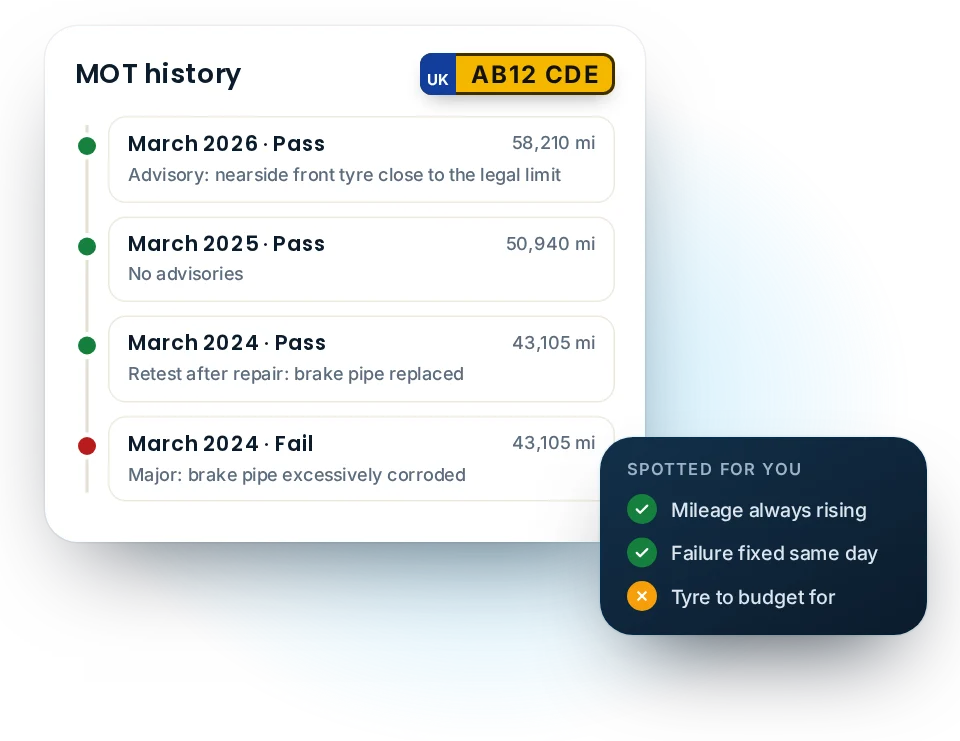
On top of the raw record, our report works out a few things that GOV.UK doesn't. It calculates a lifetime pass rate, charts the mileage, flags any reading that goes down and picks out faults that keep coming back. Where DVSA holds the information, it also tells you about an outstanding safety recall.
How to read an MOT history, step by step
A long list of tests can look daunting. However, you can read most histories in under five minutes if you follow the same order every time:
- Start with the latest test It tells you the car's condition most recently. Note any advisories, because they're the next owner's job.
- Look at every fail, then the very next test A pass on the same day or soon after means the fault was fixed. A long gap deserves a question.
- Hunt for repeat advisories The same wording two or three years running shows a problem that's been watched, not fixed.
- Follow the mileage It should rise every year. A drop, or a year with almost no miles, needs an explanation.
- Check the gaps between tests A missing year can mean the car was off the road, or driven without an MOT.
- Read the dangerous items twice One dangerous defect in the past isn't a deal-breaker, as long as it was clearly repaired.
MOT results in brief
Since 20 May 2018, testers in Great Britain have sorted every problem into one of four categories, plus a fifth note for faults fixed on the spot:
- Dangerous and major defects fail the test.
- Minor defects and advisories pass, but they're worth budgeting for.
- PRS (pass after rectification) means the fault was repaired during the test, so the car passed.
Remember that a fail with a dangerous defect means the vehicle can't legally be driven until it's repaired. Our guide to MOT defect categories explains each one with real examples.
Common MOT advisories and what they mean
Advisories are the most useful part of any MOT history check, because they show what's likely to need money next. Here are the ones buyers see most often, translated into plain English.
| Advisory wording | What it usually means | What to do |
|---|---|---|
| Tyre worn close to legal limit | Tread is near the legal minimum of 1.6mm for cars | Budget for a new tyre soon. It will fail once it's below the limit |
| Brake pipe slightly corroded | Surface rust on a steel brake pipe | Ask a garage to look. Pipes are often cheap to replace before they fail |
| Oil leak, but not excessive | Oil is escaping, but not enough to fail | Find the source. A small leak can still damage rubber parts over time |
| Suspension arm pin or bush worn | Rubber bushes are breaking down | Expect vague handling or knocking. Common on older, high-mileage cars |
| Corrosion to underside | Rust that isn't yet weakening the structure | Inspect closely. Rust near suspension or seat belt mounts can become a fail |
| Brake disc worn, pitted or scored | The disc surface is wearing | Discs and pads are often replaced together. Ask when they were last done |
| Exhaust has a minor leak | A small leak, below the failure point | Fix it before it grows, especially near the catalytic converter |
For a fuller list, see MOT advisories explained.
Patterns that tell the real story
Single results matter less than the story across several years. So, once you've read each test, step back and look for these patterns:
- The same advisory, year after year. "Corrosion" or "oil leak" three times running suggests an owner who drove on rather than repaired. Our report groups these as "faults that keep coming back".
- A fail, then a pass the same day. Usually a good sign: the problem was found and fixed straight away.
- A short MOT history for the car's age. Check whether it was imported, exempt or kept on a SORN. A free DVLA vehicle check shows the first registration date and tax status.
- A change of registration. The plate shown at each test reveals when a private number was added or removed. That's normal, but the V5C should match.
- Big jumps in yearly mileage. A car that covered 4,000 miles a year and then 25,000 may have changed use, for example to a delivery or taxi role.
MOT mileage history
Every MOT records the odometer reading. As a result, an MOT history check is one of the best free ways to catch a clocked car. Mileage should only go up. If a reading falls, the report highlights it in amber.
A single odd reading followed by normal ones is often a typing mistake at the test centre. Even so, ask the seller about it, and look for service records that agree with the later readings. Our mileage check explains how to spot clocking in more detail.
Using an MOT history check before you buy
Run the check before you travel to see a car, and again on the day using the plate on the car itself. Then use what you've found to ask better questions:
- Ask whether the latest advisories have been fixed, and ask to see the invoices.
- Ask about any fail that wasn't followed by a quick pass.
- Match the mileage on the dashboard to the latest MOT reading.
- Check the registration on the car matches the one you searched.
- Agree any sale subject to the car still having a valid MOT on the day.
A long, clean MOT history with steady mileage and few advisories is one of the best signs of a well-kept car. Nevertheless, it isn't a guarantee, so still inspect the car in daylight and, ideally, have a mechanic look it over.
What MOT history covers, and what it doesn't
For cars, vans and motorcycles, DVSA's records cover tests in Great Britain from 2005 and in Northern Ireland from 2017. For lorries, buses and trailers, they start in 2018 in Great Britain and 2017 in Northern Ireland.
However, an MOT history won't show servicing, repairs carried out between tests, or accident damage that a tester didn't need to record. Nor will it show outstanding finance, write-offs or theft, which only paid history checks cover. Our data sources page lists the exact fields and their limits.
How to get a copy of an MOT certificate
You don't need the paper certificate any more, because the official record lives online. GOV.UK's check MOT history service lets you view and download a test certificate. Alternatively, the test centre that did the MOT can print one for you.
If the mileage or vehicle details on a record are wrong, the MOT centre can correct the mileage within 28 days of the test. After that, use GOV.UK's fix mistakes on your MOT record form.
MOT history check: frequently asked questions
Is an MOT history check free?
Yes. MOT history is public information, and checking it is free on GOV.UK and on MOT Check Online. You only need the registration number.
How far back does MOT history go?
For cars, vans and motorcycles, MOT history goes back to 2005 in Great Britain and 2017 in Northern Ireland. Older paper records weren't added to the database.
Can I check MOT history without the V5C logbook?
Yes. The registration is all you need to see the full MOT history. The V5C isn't required for a check.
Why is there no MOT history for my car?
Most often, the car is under three years old and hasn't needed a test yet. It can also be exempt, newly imported, or tested in Northern Ireland before 2017.
Does MOT history show accident damage?
Not directly. It only shows what testers recorded at each MOT. Damage that was repaired, or didn't affect the test, won't appear. A paid history check shows insurance write-offs.
Do MOT advisories affect a car's value?
They can. Buyers and dealers use advisories to estimate upcoming costs, so a history full of unrepaired advisories usually means a lower offer.
Is MOT history the same as service history?
No. MOT history shows the annual safety test only. Service history shows maintenance such as oil changes, recorded in the service book or by the garage.
Run a free MOT history check
See every test, advisory and mileage reading for any UK vehicle. An MOT history check takes one registration and a few seconds.