
Data sources: where our MOT history data comes from
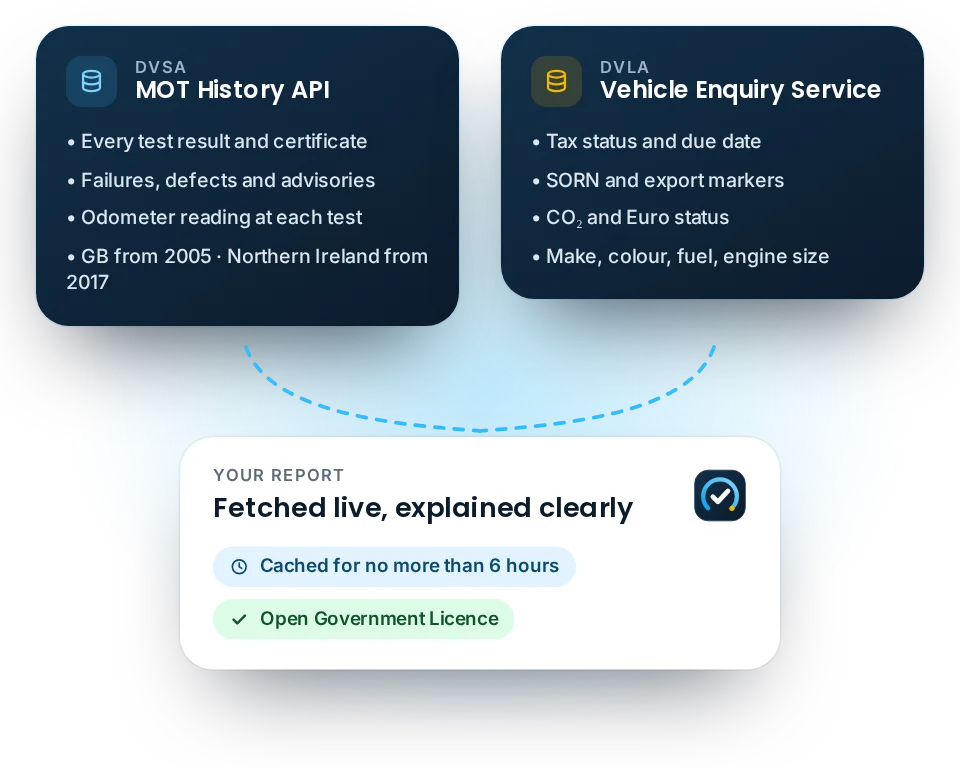
Every report on MOT Check Online is built from official MOT history data and vehicle records published by two UK government agencies. In other words, nothing is estimated, scraped from other sites or bought from a data broker. This page sets out each source, the exact information it provides, how current it is and, just as importantly, what it can't tell you.
Updated · Written by Hamza Akram, who built the connections to both services
Our two official sources at a glance
| Source | Run by | What it gives us | Coverage |
|---|---|---|---|
| MOT History API | Driver and Vehicle Standards Agency (DVSA) | Test results, expiry dates, defects, advisories and odometer readings | Cars, vans and motorcycles: Great Britain from 2005, Northern Ireland from 2017 |
| Vehicle Enquiry Service API | Driver and Vehicle Licensing Agency (DVLA) | Tax status and due date, SORN, emissions and specification | Vehicles registered with DVLA |
Both agencies publish these services so that approved organisations can build tools like ours. Accordingly, we registered for each one, and every lookup uses our own access keys over an encrypted connection.
DVSA MOT History API
The DVSA approves MOT centres and testers, and it keeps the national record of every test. Its MOT History API draws on the same national MOT records as GOV.UK's own check MOT history service.
What this MOT history data includes
- Each test: the date, the result (pass or fail), the expiry date of a passed test and the MOT test number.
- Defects: every item a tester recorded, with its category: dangerous, major, minor or advisory. Items repaired during the test also appear.
- Odometer readings: the mileage and its unit at every test, which is how we spot a reading that goes down.
- Vehicle details: make, model, fuel type, colour, engine size, and registration and manufacture dates.
- First MOT due date: for newer vehicles that haven't had a test yet.
By contrast, for heavier vehicles such as lorries, buses and trailers, the records start in 2018 for Great Britain and 2017 for Northern Ireland.
What it doesn't include
Equally, there are gaps. MOT history data won't show tests from before 2005, servicing or repair invoices, or anything about owners and keepers. It also has nothing on vehicles that are exempt from the MOT, such as most cars over 40 years old.
DVLA Vehicle Enquiry Service
The DVLA registers vehicles and collects vehicle tax. Its Vehicle Enquiry Service gives us the details you'd otherwise find through GOV.UK's vehicle information service:
| Area | Details |
|---|---|
| Tax | Tax status (taxed, untaxed or SORN) and the tax due date |
| Registration | Month of first registration, year of manufacture and the date the latest V5C logbook was issued |
| Emissions | CO₂ figure, Euro status and real driving emissions (RDE) where held |
| Specification | Make, colour, fuel type, engine capacity, wheelplan, type approval and revenue weight |
| Markers | Whether the vehicle is marked for export |
Importantly, it contains no keeper names or addresses. In addition, the DVLA states that it can't guarantee the accuracy of every record, particularly where details came from vehicle keepers, so a small number of entries may be out of date.
How a check works, step by step
Here's what happens in the few seconds after you press "Check":
- Tidy the registration Spaces and lower-case letters are fine. We format the plate the way both agencies expect it.
- Ask both agencies Next, requests go to DVSA and DVLA over encrypted connections, using our own access keys.
- Hold the answer briefly Then the combined result stays in a short-term cache for up to six hours, then it expires.
- Explain what came back After that, defects are sorted by severity, mileage is charted, and dates become countdowns you can read at a glance.
- Flag anything missing Finally, if one service doesn't answer, you still see the other part, with a note saying what's missing.
How current is the MOT history data?
DVSA's records update as MOT centres submit their results. Similarly, DVLA updates tax and SORN status as payments and declarations go through. Our reports fetch both live.
The only delay we add is the six-hour cache. In other words, if someone checked the same vehicle earlier today, you might see that earlier result for a few hours. That's rarely an issue. However, it can matter on the day of a new MOT or a tax payment, so in that case check again later in the day.
What we add, and what we never change
We never alter the official figures. Instead, every date, result, defect and mileage reading appears exactly as DVSA or DVLA supplied it. What we add sits around that data:
- Plain-English explanations of each defect and status.
- Colour coding by severity, from dangerous to advisory.
- Calculations such as days left on the MOT and tax, average yearly mileage and the gap between tests.
- Warnings we raise automatically, for example a falling odometer reading, a SORN or an export marker.
About the car pictures
The photo on a report is a stock image of the same make and model, not a picture of the actual vehicle. We find it by make and model only, through image services such as Imagin, CarImagery (regcheck.org.uk) and Wikipedia, and the brand badge comes from carlogos.org. None of them ever receives the registration you searched.
Known limits of MOT history data
Official records are reliable, but they aren't perfect. So keep these limits in mind:
- Typing errors happen. For example, a tester can enter the wrong mileage. A single odd reading followed by normal ones is often a mistake rather than clocking.
- Northern Ireland records start in 2017 for cars, vans and motorcycles. Therefore, older Northern Irish tests won't appear.
- Exempt vehicles may also have long gaps, because many vehicles over 40 years old no longer need an MOT.
- No finance, write-off or theft data. MOT and tax records don't hold them. For a car you're about to buy, a paid vehicle history check covers those risks.
Spotted something wrong?
We can't edit official records. However, the right people can, and here's who to ask:
| Problem | Who can fix it |
|---|---|
| Wrong mileage, within 28 days of the test | The MOT centre that did the test |
| Wrong mileage after 28 days, or wrong vehicle details on an MOT | DVSA, through GOV.UK's fix mistakes on your MOT record form |
| A test missing from the record | DVSA, by email at enquiries@dvsa.gov.uk or on 0300 123 9000 |
| Wrong tax status or vehicle details at DVLA | The DVLA, via GOV.UK's DVLA contact page |
| A mistake in our explanation or calculation | Us, through the contact page |
Licence and attribution
Contains public sector information licensed under the Open Government Licence v3.0. The licence lets us reuse and explain the records, provided we credit the source and don't suggest official status. Accordingly, MOT Check Online is independent and isn't endorsed by DVSA, DVLA or any government department.
On the other hand, our explanations, design, charts and guides are our own work. Read more about who we are on our about page.
Other sources behind our guides
Reports use the two live sources above. Our guides, meanwhile, draw on:
- GOV.UK guidance on MOTs, vehicle tax and SORN, including current fees and rates.
- The MOT inspection manual, which tells testers exactly what passes and fails.
- UK legislation, such as the Road Traffic Act 1988, for legal duties and penalties.
- DVSA statistics, including MOT testing data for Great Britain, for pass rates and common failures.
Our editorial policy explains how we rank and check each of these.
MOT history data: frequently asked questions
Is the MOT history data on MOT Check Online official?
Yes. It comes straight from the DVSA MOT History API, which draws on the same national records as GOV.UK's own MOT history service. We add explanations, but we never change the figures.
How far back does MOT history go?
For cars, vans and motorcycles, records cover tests in Great Britain from 2005 and in Northern Ireland from 2017.
Why doesn't my latest MOT show yet?
Results can take a few hours to reach us, because we cache each check for up to six hours. Also, the MOT centre must record the test first. If a test is still missing after a day or two, contact DVSA.
Can I see previous owners or keepers?
No. Neither DVSA nor DVLA share keeper details through these services, and we don't hold them. Instead, your V5C logbook shows the number of previous keepers.
Why does the car photo look different from my vehicle?
The photo is a stock picture of the same make and model, chosen without the registration. As a result, colour, trim and wheels may differ from your car.
Can I reuse MOT history data from your reports?
The underlying government data is available under the Open Government Licence. However, our explanations and design are ours, and automated copying of our report pages isn't allowed under our terms of use.
Whenever you run a check, you're seeing the same MOT history data the government holds, made easier to read. To try it now, start an MOT history check.