

How Much Is My Car Tax? Free Car Tax Calculator
How much is my car tax? Use our free car tax calculator to work it out for any car, van or motorbike. Enter the registration and we'll fill in the details from DVLA, or type them in yourself. You'll see the yearly cost at the 2026/27 rates, every way to pay and what you'll pay over the next five years.
- GOV.UK rates from 1 April 2026
- Every car, van and motorbike
- Free, with no sign-up
Updated · By Hamza Akram · Rates checked against GOV.UK
How much is my car tax? The short answer
Quick answer
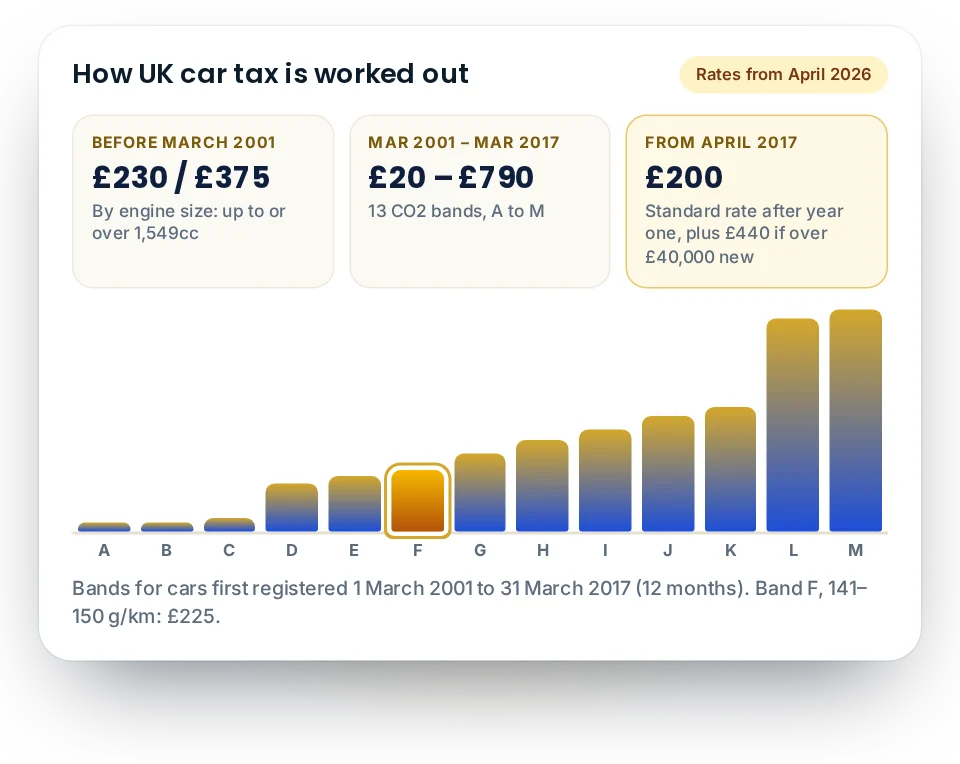
It depends on when the car was first registered. Most cars registered from 1 April 2017 pay £200 a year, plus £440 a year for five years if the list price was over £40,000. Cars registered between 1 March 2001 and 31 March 2017 pay £20 to £790, depending on their CO2 band. Cars registered before 1 March 2001 pay £230 or £375, depending on engine size.
Vehicle tax is also called road tax or Vehicle Excise Duty (VED). In other words, they're all the same thing, and DVLA collects it.
How much is my car tax by reg? Using the car tax calculator
The car tax calculator works in two ways, depending on what you have to hand:
- By registration Enter the number plate. We read the first registration date, fuel, CO2 figure, engine size and any expensive car supplement from DVLA.
- Enter the details Choose car, van or motorcycle, then add the month and year of first registration, the fuel and the CO2 figure or engine size.
- Read the result See the yearly price, your band, every way to pay and the cost for the next five years.
- Adjust and compare Press "Adjust the details" to try a different fuel, CO2 figure or list price, for example before you buy.
For example, the CO2 figure is in section V.7 of the V5C logbook, the fuel in P.3 and the engine size in P.1.
Is this the DVLA car tax calculator?
DVLA doesn't publish a calculator. Instead, GOV.UK lists the rates and DVLA confirms the amount when you tax the vehicle. Our calculator applies those GOV.UK rates to the official DVLA details for the registration, so the result should match. We're independent, not part of DVLA.
Looking for a company car tax calculator? That's a different tax, called benefit in kind, which an employee pays through income tax. This page covers vehicle tax (VED) only.
Car tax rates for cars registered from April 2017
Cars first registered on or after 1 April 2017 pay a one-off first-year rate based on CO2 emissions. After that, they pay the same standard rate each year. The dealer usually pays the first-year rate when the car is registered, so it's built into the price of a new car.
| CO2 emissions | Petrol, RDE2 diesel, hybrid and electric | All other diesel cars |
|---|---|---|
| 0g/km | £10 | £10 |
| 1 to 50g/km | £115 | £135 |
| 51 to 75g/km | £135 | £280 |
| 76 to 90g/km | £280 | £365 |
| 91 to 100g/km | £365 | £405 |
| 101 to 110g/km | £405 | £455 |
| 111 to 130g/km | £455 | £560 |
| 131 to 150g/km | £560 | £1,410 |
| 151 to 170g/km | £1,410 | £2,270 |
| 171 to 190g/km | £2,270 | £3,420 |
| 191 to 225g/km | £3,420 | £4,850 |
| 226 to 255g/km | £4,850 | £5,690 |
| Over 255g/km | £5,690 | Same as petrol (£5,690) |
Then, from the second year, the standard rate is £200 a year for every fuel type, as GOV.UK's vehicle tax rate tables show. Hybrids and other alternative fuel cars now pay the same as petrol cars.
The expensive car supplement
If a car's list price was over £40,000, you pay an extra £440 a year for five years. This expensive car supplement starts the second time the car is taxed, so most owners pay it from year two to year six. After that, the car drops back to the standard rate.
For electric cars, the rules are different:
- Registered before 1 April 2025: zero emission cars don't pay the supplement, whatever the list price.
- Registered from 1 April 2025: the supplement applies when the list price was over £50,000.
Above all, remember that the list price is the published price before the car was first registered, including options, before any discounts. It isn't what you paid, so a used car can still owe the supplement.
| How you pay | Standard rate | With the £440 supplement |
|---|---|---|
| 12 months, single payment | £200 | £640 |
| 12 months by Direct Debit | £200 | £640 |
| 12 monthly Direct Debits | £210 (£17.50 a month) | £672 (£56 a month) |
| 6 months, single payment | £110 | £352 |
| 6 months by Direct Debit | £105 | £336 |
Car tax bands for cars registered 2001 to 2017
Cars first registered between 1 March 2001 and 31 March 2017 are taxed on CO2 emissions, in 13 bands from A to M. Also, every fuel pays the same, including electric cars in band A.
| Band | CO2 emissions | 12 months | 6 months |
|---|---|---|---|
| A | Up to 100g/km | £20 | Not offered |
| B | 101 to 110g/km | £20 | Not offered |
| C | 111 to 120g/km | £35 | Not offered |
| D | 121 to 130g/km | £170 | £93.50 |
| E | 131 to 140g/km | £200 | £110 |
| F | 141 to 150g/km | £225 | £123.75 |
| G | 151 to 165g/km | £275 | £151.25 |
| H | 166 to 175g/km | £325 | £178.75 |
| I | 176 to 185g/km | £360 | £198 |
| J | 186 to 200g/km | £410 | £225.50 |
| K | 201 to 225g/km | £445 | £244.75 |
| L | 226 to 255g/km | £760 | £418 |
| M | Over 255g/km | £790 | £434.50 |
However, there's one exception. Cars over 225g/km registered before 23 March 2006 stay in band K. That's why the car tax calculator asks for the registration month as well as the year.
Cars registered before March 2001
By contrast, older cars are taxed on engine size, not emissions. A car with an engine up to 1,549cc pays £230 a year, while a larger engine pays £375. The same rates apply to light goods vehicles from before March 2001.
What's more, many of these cars are now classics. From 1 April 2026, vehicles built before 1 January 1986 can go in the historic vehicle tax class, which costs nothing. You do still have to apply for it and tax the vehicle each year.
How much is car tax on an electric car?
Electric cars have paid vehicle tax since 1 April 2025. However, how much they pay depends on when the car was first registered:
| First registered | What you pay |
|---|---|
| From 1 April 2025 | £10 in the first year, then £200 a year, plus £440 for five years if the list price was over £50,000 |
| 1 April 2017 to 31 March 2025 | £200 a year, with no expensive car supplement |
| 1 March 2001 to 31 March 2017 | £20 a year (band A) |
Car tax calculator for vans and motorcycles
The car tax calculator handles vans and motorcycles too. Light goods vehicles registered from 1 March 2001 pay one flat rate. However, Euro 4 vans registered between 1 March 2003 and 31 December 2006, and Euro 5 vans registered between 1 January 2009 and 31 December 2010, pay a lower rate.
| Vehicle | 12 months | 6 months |
|---|---|---|
| Van (light goods vehicle) | £360 | £198 |
| Euro 4 or Euro 5 van in the dates above | £140 | £77 |
| Motorcycle up to 150cc, or electric | £27 | Not offered |
| Motorcycle 151 to 400cc | £59 | £32.45 |
| Motorcycle 401 to 600cc | £90 | £49.50 |
| Motorcycle over 600cc | £125 | £68.75 |
How much is my car tax monthly?
You can pay vehicle tax in one go, every six months or monthly by Direct Debit. In general, the cheaper options are the ones that collect the money up front:
- 12 months in one payment costs the basic rate, whether you pay by card or Direct Debit.
- 12 monthly Direct Debits add 5% to the yearly total.
- 6 months in one payment adds 10%, so two of them cost more than a year.
- 6 months by Direct Debit adds 5%.
The surcharges aren't refunded if you sell the car early. So, if cash flow allows, a single 12-month payment is the cheapest choice. Our car tax calculator shows each option side by side, with the cheapest one highlighted.
Car tax calculator tips and common mistakes
A few details trip people up, especially when they're comparing cars to buy:
- Use the list price when new, not the price you paid. A used car can still owe the £440 supplement.
- Count the supplement years from first registration. A 2022 car pays it until its sixth year on the road.
- Check the registration month, not just the year. April 2017 and March 2006 both change the rules.
- Remember the tax doesn't transfer when you buy. You'll pay from the month you tax the car.
- Compare yearly totals, not monthly amounts. Monthly payments cost 5% more over a year.
To see the tax status and due date of a specific vehicle, use our free car tax check. For a fuller picture before you buy, our vehicle check and MOT history check cover the rest.
Car tax calculator: frequently asked questions
How much is car tax for a car registered in 2018?
Most cars first registered in 2018 pay the standard rate of £200 a year. If the list price was over £40,000, they paid an extra £440 a year until their sixth year, which has now ended.
Why is my car tax £640?
Your car pays the £200 standard rate plus the £440 expensive car supplement, because its list price was over £40,000. It then drops to £200 once the five years of supplement are up.
Do hybrid cars pay less car tax?
Not any more. Hybrids pay the same first-year and standard rates as petrol cars. Plug-in hybrids with very low CO2 still pay a lower first-year rate.
Is road tax the same as car tax?
Yes. Road tax, car tax, vehicle tax and Vehicle Excise Duty (VED) all mean the same charge, which DVLA collects.
Can I pay car tax monthly?
Yes, by Direct Debit. However, twelve monthly payments cost 5% more than paying for the year in one go.
How much is car tax in 2026?
From 1 April 2026, most cars pay £200 a year. Cars registered from 2001 to 2017 pay £20 to £790 by CO2 band, and older cars pay £230 or £375.
How accurate is this car tax calculator?
It uses GOV.UK's published rates from 1 April 2026 and the official DVLA details for the vehicle. DVLA confirms the exact amount when you tax it.
Check the tax status as well as the cost
The car tax calculator shows what you'll pay. A free check shows whether the vehicle is taxed right now, when its MOT runs out and its full MOT history.