

Free Mileage Check: Has This Car Been Clocked?
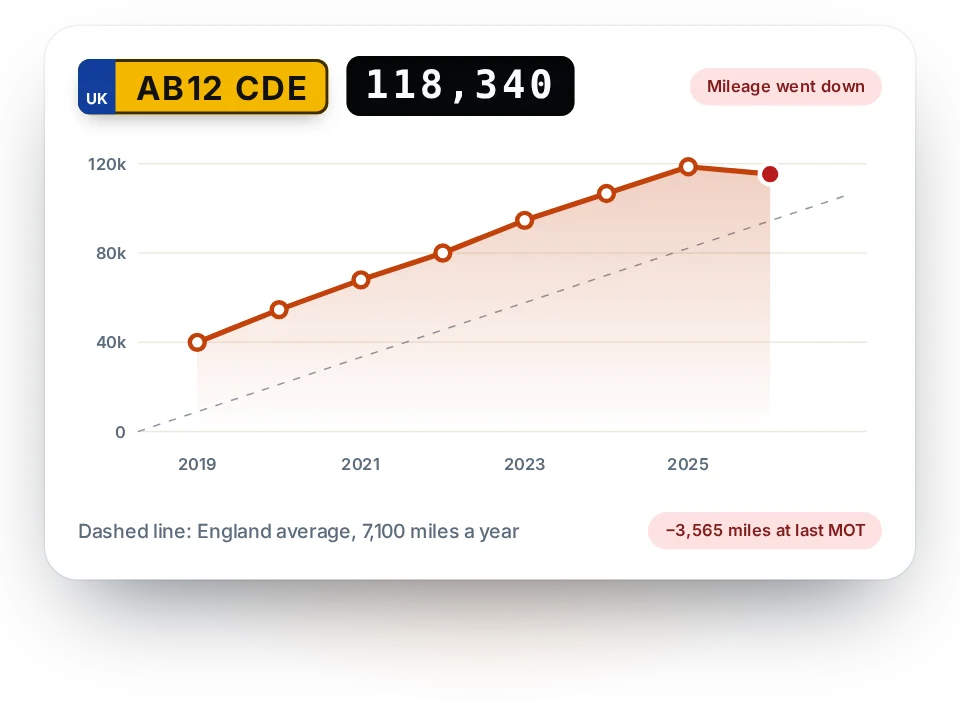
Run a free mileage check on any UK car, van or motorbike. Enter the registration and you'll see every odometer reading recorded at its MOTs, plotted on a chart. We also flag readings that go down, long gaps and unusual jumps. In addition, we compare the car's yearly mileage with the average car in England.
- Every MOT reading since 2005
- Clocking signs flagged
- Free, with no sign-up
Updated · By Hamza Akram · Where our data comes from
How to check a car's mileage
Quick answer
Enter the registration in the mileage check above. It shows every odometer reading DVSA recorded at the car's MOT tests, in date order and on a chart. Each reading should be higher than the one before. A reading that goes down, a long gap or a sudden jump is worth asking the seller about before you buy.
MOT testers record the mileage at every test. So, for any vehicle over three years old, the MOT record is the most complete free source of mileage history in the UK.
What our mileage check shows
However, a list of numbers is hard to judge. Our mileage check turns the record into answers:
Every MOT reading
Each odometer reading DVSA holds, with the test date, the change since the last test and whether the car passed.
Animated chart
The readings plotted over time, next to the pace of an average car, so a dip stands out at once.
Clocking warnings
Any reading lower than an earlier one is flagged in red, with both dates and figures.
Gaps and jumps
Over two years without a reading, or a sudden spike in use, is highlighted for you to ask about.
Yearly average
Miles a year over the car's life and the last three years, compared with the average car.
Mileage today
An estimate of the current mileage, based on how the car has been used recently.
How to read a mileage history
In most cases, a mileage history tells a simple story. Here's what the common patterns usually mean:
| Pattern | What it usually means | What to do |
|---|---|---|
| Steady rise every year | Normal, consistent use | Match the latest reading with the dashboard |
| A reading lower than the one before | A typing error at the MOT, a replaced instrument cluster or clocking | Ask for an explanation and paperwork before you buy |
| No reading for over two years | The car was off the road, stored, exempt or never tested | Ask where it was and whether it was declared SORN |
| Almost no miles for a year or more | Stored, used as a second car or laid up for repairs | Check tyres, brakes and battery for age-related wear |
| A sudden huge jump | Heavy use, such as a delivery or taxi role, or a typing error | Ask how the car was used and check the service record |
A clean mileage check is a good sign, but it isn't proof. After all, MOT readings can't show what happened between tests. That's why you should always compare them with the service history and invoices.
What is car clocking?
In short, clocking means winding back a vehicle's odometer so that it shows fewer miles than it has really covered. A lower mileage makes a car look less worn and adds to its value, so clocking is a way to overcharge the buyer.
What's more, modern digital odometers can be altered with the right equipment. In the UK, adjusting an odometer isn't illegal in itself. However, selling a car without telling the buyer about a known mileage problem is a criminal offence. Traders can be prosecuted under consumer protection law, and private sellers under the Fraud Act 2006, as Auto Express explains.
Found a drop in the mileage check?
Don't assume the worst, but don't ignore it either. Ask the seller for an explanation in writing, and for invoices or service records that show the mileage around the same dates. If the answers don't add up, walk away.
Mileage errors at the MOT and how to fix them
Not every drop in a mileage check means fraud. DVSA receives over 14,000 requests a year to correct MOT mileage readings. In most cases, the causes are simple: a tester mistyped the figure, misread the dashboard or recorded the trip meter instead of the total.
To cut these mistakes, the MOT system has warned testers since July 2022 when a reading is lower than, the same as or far higher than the last one. Even so, errors still happen. Here's how to fix one on your own car:
- Within 28 days of the test Ask the MOT centre to correct the reading. It can issue a replacement certificate.
- After 28 days Report it to DVSA with evidence of the correct mileage from the test day.
- Send the right evidence Use the MOT invoice, an emissions printout, a service receipt or a job card. It must show the correct mileage and the same date as the test.
DVSA's own blog post on improving mileage recording errors explains the process in more detail. You can also contact DVSA by email at enquiries@dvsa.gov.uk or call 0300 123 9000.
What is the average mileage in the UK?
According to the Department for Transport's National Travel Survey, the average car in England covered about 7,100 miles in 2024. That's down from around 9,200 miles in 2002.
Our mileage check therefore uses that figure to judge whether a car's use is low, typical or high. For example, the table shows what an average car would have covered by different ages.
| Age of the car | Typical mileage | Lower than average | Higher than average |
|---|---|---|---|
| 3 years | 21,300 | Under 15,000 | Over 30,000 |
| 5 years | 35,500 | Under 25,000 | Over 50,000 |
| 8 years | 56,800 | Under 40,000 | Over 80,000 |
| 10 years | 71,000 | Under 50,000 | Over 100,000 |
| 15 years | 106,500 | Under 75,000 | Over 150,000 |
Of course, high mileage isn't automatically bad. In fact, a car that's done steady motorway miles and been serviced on time can be in better shape than a low-mileage car used for short trips.
Where else to check a car's mileage
A mileage check based on MOT records covers tests from 2005 in Great Britain and 2017 in Northern Ireland. To get a full picture, then, add these sources:
- The service book or digital service record, which shows the mileage at each service.
- Invoices and receipts for tyres, repairs and parts, which often record the mileage.
- Old MOT certificates kept with the car's paperwork.
- A paid history check, which can add readings from dealers, auctions and garages between MOTs.
Similarly, a brand-new car won't have any MOT readings until its first test, three years after registration. In that case, the dealer's pre-delivery and service records are your best guide. Our MOT history check also shows the advisories recorded alongside each reading.
Mileage check before you buy: a checklist
First, run through these points on any used car, ideally before you travel to see it:
- Run a free mileage check and look for any reading lower than the one before.
- Compare the dashboard mileage with the latest MOT reading and the date it was taken.
- Match the MOT readings with the service book and invoices.
- Ask about any gap of more than two years between readings.
- Check that wear on the seats, steering wheel and pedals fits the mileage.
- Confirm the tax and MOT status with our free car tax check.
For the tax status, use our car tax check. For the vehicle's details and any red flags, try the free vehicle check.
Mileage check: frequently asked questions
Is this mileage check free?
Yes. The mileage check is free, with no sign-up. It also uses the official MOT records that DVSA publishes, so the data is the same as GOV.UK's.
How far back does the MOT mileage history go?
MOT records, including mileage, go back to 2005 in Great Britain and 2017 in Northern Ireland.
Can a mileage check prove a car hasn't been clocked?
No check can prove that. A consistent MOT record is reassuring, but the readings only show the mileage on test days. So always compare them with the service history.
Why would a car's mileage go down between MOTs?
The most common reason is a typing error at the test. Besides that, a replaced instrument cluster or, sometimes, clocking can cause it.
Is clocking illegal in the UK?
Adjusting an odometer isn't illegal in itself. However, selling a car without telling the buyer about a known mileage problem is a criminal offence.
What counts as high mileage for a used car?
Anything well above about 7,100 miles a year is higher than average. Still, how the car was driven and serviced matters more than the number alone.
Why does the mileage check show kilometres?
Some readings are in kilometres, for instance on imported cars. Our chart converts them to miles so you can compare every reading.
Check the full MOT history behind the mileage
A mileage check tells you how far the car has gone. The full free report shows what happened on the way, from fails and advisories to tax and MOT status.